A Short but gifted life
PHILIPPINE DAILY INQUIRER SUNDAY MAGAZINE
A SHORT BUT GIFTED LIFE
BY NENI STA ROMANA CRUZ
Philippine Daily Inquirer Sunday Magazine- Sept 12,2010
“I will meet a child who is a very strong supporter of mine,” P-Noy was quoted as saying. “I really want to give some comfort to the kid who stood by me and who campaigned for me for such a long time.”
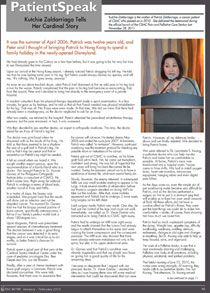
Not many people know that the child was 16-year old Kristoffer Patrick Rañola Zaldarriaga, a junior high school student at Xavier School. Strikingly handsome and intelligent, Patrick had been diagnosed with bone cancer when he was 12 and then a sixth grader. The Zaldarriaga family was in Hong Kong Disneyland for a summer trip when Patrick’s mom noticed that their only child was limping on his left leg, where he also felt some pain. It was initially misdiagnosed as a pulled muscle during a hospital check up, but after two weeks of physical therapy that gave the boy no relief, he was asked to undergo an x-ray.
Patrick cried when he found out he had osteosarcoma, a rare kind of bone cancer, scared and horrified as he was with the diagnosis. He was afraid to die and worried over what the doctors would do to make him live. He was given six months to live if the prescribed chemo treatment did not work. Patrick underwent chemotherapy for one year and was in remission for two.
His faith was to be further tested. Slowly, the cancer returned with a vengeance. A series of surgeries became necessary, each one an attempt to find the elusive cure. The first was to remove the nodules on his lungs, where the cancer had spread. The second opened up his left lung to remove more nodules that had grown. The third again involved opening the left lung with the complication of a tumor near the spine and the abdominal aorta. The doctors could not promise they could do the job – but they did.
However, the fourth lung and abdominal surgery proved to be a critical turning point as the doctors, led by orthopedic surgeon Dr. Vince Gomez and thoracic surgeon Dr. Gervy Ignacio, could not remove the tumor attached to the abdominal aorta and the spine. They feared that continuing the surgery would pose a mortality risk right on the operating table. It was just a matter of time for the metastasis to spread to the abdomen, lungs, and spine. The doctors admitted that they had exhausted what medical science could possibly do.
This was devastating for his parents, Peter and Kutchie Zaldarriaga, who went on to seek alternative treatments for their only child. The prospect of loss was real and brought unspeakable pain and near-depression, yet they knew they had to be brave for Patrick.
He was as brave.
From the start, Patrick wanted to know the full details about his condition, asking his parents not to keep any secrets from him. He knew the implications of the disease, the medicines he had to take, when to take them and their exact dosage – he was very meticulous in that respect.
Through all these, the boy had always maintained a brave front, never whining nor complaining for he did not want his family to be worried about him. An aunt, Zonny Rañola describes him as “an adult trapped inside the body of a little boy.” He was mature beyond his years.
Patrick was always in an upbeat mood and did not like people openly crying over his condition. When told early this year that he only had a few months to live, he asked his parents not to tell anyone, not wanting to cause worry and sadness among his friends, wanting to fight his final battle alone. “This was between him and God,” his father recalls his son telling him.
Patrick had been in and out of the hospital since he was 12 and missed school a lot. But thanks to Xavier School’s home study program, he was able to graduate from Grade 7 – without his crutches, too. His lessons, worksheets and assignments would be e-mailed to him, and a private tutor would visit him weekly. On good days, he would visit the school at least once a week. He went on to sophomore year, which he did not complete because of the series of surgeries he had to undergo. Despite his ailment, Patrick maintained an active student life, continuing to write for the school paper, The Stallion, as features editor. He even participated in writing competitions and won 3rd place in one of them.
The boy was intelligent enough to know that he was facing great odds in fighting the disease, but he never lost hope. Four weeks before his passing, he experienced paralysis from the waist down; he became very quiet and reflective. He asked to be brought to the shrine of Our Lady of Manaoag in Pangasinan because he wanted to talk to her.
When he found his mom in tears, Patrick asked her to stop because as far as he was concerned, he was happy that soon all treatments would finally be over after four long years. He told her, “…finally we are free from doctors, constant monitoring, endless hospital stays and I can just happily stay home.”
The day he found out that President-elect Noynoy was going to visit him, he thought it was a big joke. Why would such a busy and important person take the time? Little did he know that the mother of one of his classmates (who wishes to remain anonymous) had casually mentioned to her close friend, Viel Aquino Dee, about this boy who would campaign for the then presidential candidate from his crutches or wheelchair. Every time he would go to Rockwell or anywhere else, Patrick would wear his yellow shirt with the Philippine map and his baller IDs. He knew the wheelchair and the yellow garb would draw attention – which was precisely what he wanted.
From the day that Aquino declared his candidacy, Patrick was already an avid supporter. When the president-elect asked him why, the nationalistic boy said, “I am looking for the perfect image of a leader who represents a clean government and can put credibility back in it. I don’t care if the other candidates are very good. I want someone honest who will not steal from the coffers of the country.”
During his private 20-minute conversation with Patrick, with only his parents present, P-Noy asked the boy if there was anything else he wanted from him. Would he want to visit Malacañang? But all Patrick wanted was for the newly-elected leader to lead by example and to remain simple.
That visit, totally unexpected, certainly perked up the boy. He proudly wore the P-Noy watch given him and was very appreciative of the DVDs of Noy’s campaign all over the country. His parents were touched by that hour-long visit, when the new President cheered up Patrick, enjoyed the merienda they served him, and did the celebrity ritual of photos and autographs.
Patrick may have missed the opportunity of being part of an audience with US President Obama as the selected school rep, but this presidential audience was no less momentous. On June 12, close to a month after the surprise visit, Patrick passed away in the emergency room of Cardinal Santos Hospital. He had gained freedom on a significant day and had written about it: “My bones are shattered. My pride is shattered. But in the midst of this self-inflicted pain, I can see my beautiful rescue.”
These days, Peter and Kutchie Zaldarriaga continue to draw strength and courage from the memories of 16 years of Patrick’s life and the heartwarming stories from those who knew him.
His best friend from first grade, Kevin Yang, remembers how they first met. He had been nervous as he entered the room, looking for his name on the last desk where he, with his “Y” surname, was sure he would be seated. To his delight, he found a happy and chubby kid whose name he could not pronounce, “Zaldaga, is it?” “Zaldarriaga,” Patrick had answered, exuding much confidence. That was the beginning of a steadfast friendship that was nurtured over the years – through shared gigs in Rockwell, where Patrick in healthier times would dance unabashedly in PowerBowl when dance music automatically played at 10 p.m. This had always embarrassed Kevin, who even threatened that he would stop being Patrick’s friend if he wouldn’t stop. But Patrick would just go on dancing.
Kevin says that his friend’s courage during his illness was admirable. His friends seemed more afraid than Patrick himself was. “He was a child taking on a man’s burden, and yet he never stopped fighting, even when fighting didn’t make sense anymore.”
A classmate, Matthew Tan, similarly remembers Patrick’s jolly mood, when he challenged another classmate in crutches to a race.
Kevin’s elder sister Kay says that menacing as cancer is, it has its limitations, for “It cannot, and has not, defeated Patrick Zaldarriaga.” She observes that it is always easier to say that he is now in a better place, but admits that she would’ve liked him to still be around. There is comfort though in Patrick’s own words, “I’m merely borrowing this life, which isn’t mine. This was a borrowed soul, a borrowed time.”
At the wake were many reminders of a short life richly lived. The proud display of Patrick’s Katangi-tangi Xavierian Award and his many wrestling belts draped over his casket were evidence of the champion that he was. Among the many who came to bid Patrick farewell were P-Noy and his sister Viel with her husband Dodo Dee, who came on separate visits.
While Patrick’s parents try to busy themselves with work (Peter is a businessman while Kutchie is a highly-rated wedding planner) after his passing, they feel that they have “lost their balance.” Their thoughts are constantly of Patrick, how he loved current events and dreamt of being a journalist like his idol Anderson Cooper of CNN, how the finality of the loss is the most difficult to accept, how they still feel the pain for him now, remembering all that their son had to endure. This was a child they had nurtured and loved, but there was little they could do to shield him when illness struck.
Kutchie says of their unspeakable sadness, “It creeps in at night, when the world is still…”
Days after he was interred, Xavier School honored Patrick at a school assembly with the Magis Award in recognition of his outstanding qualities as a student. In Peter Zaldarriaga’s response, he spoke of the lessons he and wife Kutchie learned from their son, acknowledged as gifted with a wonderful sense of humor, but not gifted with a long life. Among these lessons was courage, for throughout the four years, Patrick seemed like a soldier ready for battle, not once losing hope. He also narrated how his son regarded his parents as true friends with whom he could be open, even about the girls he was interested in. There was also his great joy and contentment that cancer could not take away, for his smile “exposed more than just braced teeth.”
The way he lived his last difficult years points the way for us “to cope with life once again… and to move on,” says Patrick’s father.
It could not have been a wasted life with such a legacy from the youthful Patrick. Truly, it is not the number of years one has lived, but the quality of those years that makes all the difference. •